Show will go on… youth charity keeps theatre lights on
London Youth Theatre had been using the studios for lessons, but faced being made homeless
Friday, 10th April — By Dan Carrier
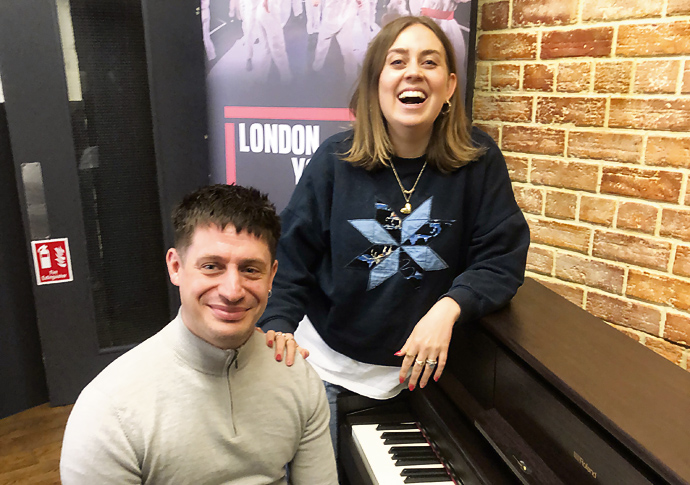
Tom Foskett-Barnes and Katie Pesskin at the London Youth Theatre
IT is in the heart of the West End, with legendary theatres just a curtain call away, a building meant for performance not silence.
But amid uncertainty about the future of the Seven Dials Playhouse in Tower Street, Covent Garden, and a risk that it could be left to stand unused, the keys have been given to a charity aiming to make it a social hub for the next generation of thespians.
London Youth Theatre has been told it can use it for at least a year while a decision about developing the building, also known as the Actors Centre is reached.
It had been using the studios for theatre lessons, but faced being made homeless when the playhouse closed at the end of last month (see below).
But the LYT’s founders Katie Pesskin and Tom Foskett-Barnes are now working to get the space ready for new talents.
Pesskin said: “Three weeks ago, we faced being homeless. We thought it would be so disheartening to see this building empty, it is often very busy, used by visiting companies and countless actors.”
The LYT, with council support, has now signed a 12-month agreement with the building’s owners.
Pesskin said: “Our plan is to keep the doors open, the lights on and use the space for a whole range of projects. And we are open to suggestions. We aim to spend 12 months developing a longer term strategy. There is a lot of support and goodwill and we want to be worthy custodians.”
Pesskin is a director, while Foskett-Barnes is a musician and composer.
They met working on a Shakespeare tour and originally set up an arts vehicle called Musical Youth London.
It offered training for young people regardless of background and income.
Pesskin said: “It was musical theatre, lots of singing, lots of music-making.”
It became the London Youth Theatre post-Covid 19 and now runs courses to increase access to musical theatre.
Foskett-Barnes said: “We created a space that is somewhere between school and education, home life and social life.
“People can feel self-conscious about performance. It sometimes isn’t perceived as being cool. Alongside this, we have seen an absolute decimation of arts in school curriculums. Fewer people are taking the performing arts subjects at GCSE level. We can help fill that gap.
“This is all about the arts being accessible.”
The LYT runs annual courses which give students a range of experiences.
It includes masterclasses with industry experts and everything from puppetry to improvisation, stagecraft and management, through to sound and lighting design.
Pesskin added: “People consider the West End to be the theatre capital of the world.
“Much of it is commercial, and yet there are grassroots venues vital to the industry here.”
And Foskett-Barnes said theatre can be an antidote to the pressures young people face today.
“Theatre is only done in person, not online,” he said.
“It helps build relationships. It is a space people can express themselves creatively, where young people can be treated as individuals and not as a homogenous group.”
Final curtain falls at playhouse
The Extra’s page 1 report of May 23 2025
A FINAL curtain has fallen on a decades-old community theatre which has helped train some of the country’s foremost acting greats, writes Tom Foot.
The Seven Dials Playhouse, formerly the Actors Centre in Tower Street, Covent Garden, “can no longer continue operating on a viable basis”, according to its board of trustees.
Ticket-holders for forthcoming shows are being contacted about refunds.
In a statement, the SDP’s chief executive Amanda Davey said: “This is an incredibly painful moment for everyone who has cared for, worked in and built Seven Dials Playhouse.
“I am immensely proud of our staff team, who have shown extraordinary compassion, professionalism and resilience through an exceptionally difficult period.
“Seven Dials Playhouse has mattered deeply to so many creatives, independent companies and audiences, and I know this loss will be felt across our community and across the wider sector.”
The Extra reported last year how an investigation had been launched into “financial concerns” at the SDP that had been triggered by a campaign by led actors including Simon Callow, Dame Judi Dench and Sir Mark Rylance.
The Charity Commission had raised concerns in a public statement about documents and filing deadlines, but the SDP had said this risked causing “reputational damage” to the organisation.
It had in 2024 been forced into the sell part of its base in Tower Street, for £3.6million, but most of the funds raised had gone on clearing historic debt.
Membership of the Actors Centre had nose-dived from around 2,200 members before Covid to just 75 “consistently participating”, it had added.
Thirteen members of staff, some part-time, will lose their jobs.
For decades the centre provided hundreds – sometimes thousands – of training workshops a year.
But last year the SDP said, the workshops were being “routinely cancelled” due to low attendance and this meant members were getting “little or no benefit from their subscriptions”, it said.
The charity moved away from the training function towards one-off events and shows, but this had not worked either.
The original Actors Centre was set up in 1978 by Clive Swift as a place where actors could continue training and support each other. It was inspired by the model of American actor workshops where performers honed their craft regardless of whether they were on stage or screen. One of the founding principles was to offer training for actors after they had finished formal education, a concept rare in this country at the time.
In January, the campaign group unveiled a new Actors Centre would be based at the Marylebone Theatre.
