‘Services key to fixing rough sleeping crisis’
Charity leader wants to meet the PM over pledge to end homelessness
Friday, 21st August — By Caitlin Maskell
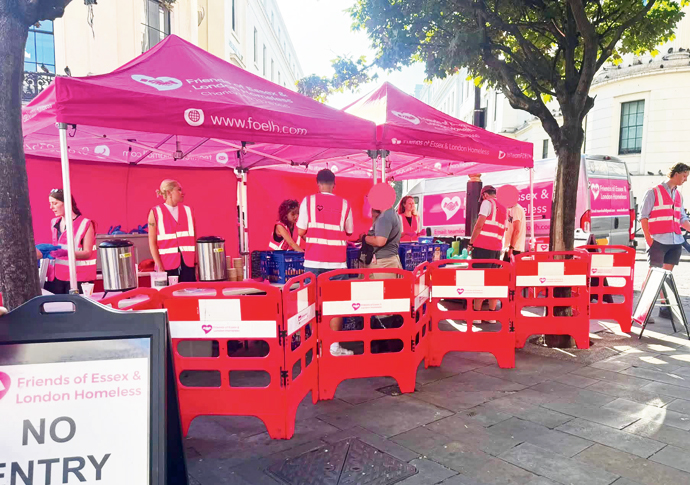
Volunteers setting up the Charing Cross soup kitchen
A CHARITY that feeds people experiencing homelessness every week in the Strand has warned that the prime minister’s plan to get every person sleeping rough off the streets by Christmas will not be a “hard” fix to the crisis unless proper support services are in place.
Steven Stuart, co-founder, volunteer and trustee of FOELH, Friends of Essex & London Homeless, runs a weekly soup kitchen in Charing Cross alongside his wife Cheryl. The charity, founded in 2016, serves around 150 people every Wednesday evening in Agar Street, with volunteers handing out hot meals, clothes, and sleeping bags to people who are rough sleeping.
But in recent months, he said, the charity had come under pressure from Westminster City Council following a string of complaints about the soup kitchen. The council had claimed the charity was drawing “large crowds of the most vulnerable people gathering in a confined area”, and had sent enforcement agents to the site. It said it cannot continue operating as it currently does after complaints about anti-social behaviour, littering, and crime.
Stuart said he felt let down by the council’s attitude and called on Andy Burnham to meet him at the table after the PM’s pledge to end homelessness in the capital.
He said: “It definitely feels like the council wants to go down this attacking route. This whole thing about getting people off the streets for Christmas, I view this as a sticky plaster, them thinking they can remove what they can see and if it’s not there it doesn’t exist.
“We do worry about our future and we will come up with workable solutions, so long as we all get around the table and talk. The big homeless charities that do good work could also learn a lot from the grass-roots groups on the ground seeing it day in day out.

Steven and Cheryl of FOELH
“At the end of the day all of us are equal human beings. Some of these people we are dealing with have gone through a lot and are battling addictions or fleeing something that has meant they have ended up here.
“It’s not a one-day fix and we haven’t got the services to fix the crisis. It’s a spinning plate. There needs to be a hard reset of services and we all need to be involved in that.”
FOELH works in both Charing Cross and Essex, and Stuart said that Westminster City Council had threatened it with a £500 parking fine for the vehicle it uses to transport and distribute food.
“There needs to be some reality to what we are doing,” he said. “If we weren’t there for those couple of hours on a Wednesday evening I think that anti-social behaviour would increase. I think the activity of criminality when we are there slows down, because people are getting what they need and some time to talk to someone.
“While we do create this vacuum of people that come to us, and it’s difficult for the neighbours, we are never going to get a perfect storm.”
Streets Kitchen, a grassroots homeless group, said that for years the city council had treated hunger and homelessness as an enforcement issue rather than addressing catastrophic housing failure.
A spokesperson from Streets Kitchen said: “Westminster Council is dusting off an old, shameful playbook to sweep visible poverty out of sight. We have seen this cruelty before… where people were hosed down and had their sleeping bags stripped away in the middle of the night, to the defeated byelaws that tried to ban soup runs around Westminster Cathedral. Blaming volunteers for ‘attracting drug dealing’ is a lazy, malicious deflection from decades of cuts to addiction and mental health services. A hot meal and a conversation don’t cause crime. Abandoning vulnerable people does. You cannot legislate away human hunger, and you cannot bully solidarity off our streets.”
A Westminster City Council spokesperson said the soup kitchen was not safe at present, and added: “Soup kitchens can provide a valuable service but need to be carefully managed. Operators must treat vulnerable people with dignity and take care of the surrounding area.”
