Preview: A Slow Fire, Jermyn Street Theatre
Simon Stephens’ post-apocolyptic play set in a nuclear bunker has hope for humanity at its heart
Thursday, 13th August — By Lloyd Bickham
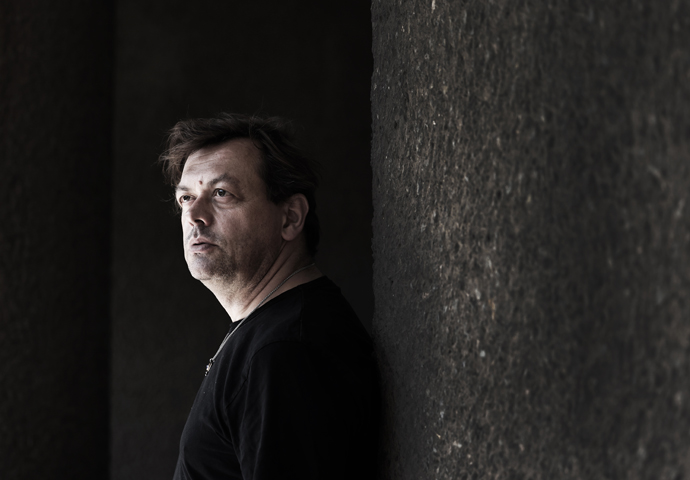
Simon Stephens: ‘The only grown-up response to a world in peril is to be optimistic’ [Kevin Cummins]
Simon Stephens is “one of the most optimistic people” he knows, which is quite the claim for a man whose latest play is set in a nuclear bunker.
He’s currently scribbling away at his desk in Hackney, desperate not to lose his train of thought.
“Could you just give me five minutes?”
The Olivier-winning writer’s heart might be in theatre, but he’s penning an un-greenlit, speculative TV project. “This stuff pays a little better.”
We’re here to talk about A Slow Fire, opening this week at Jermyn Street Theatre. It may prove less lucrative for Simon, but his tale of apocalypse-tinged optimism is one he wants on the stage.
“Theatre’s innately optimistic. There’s trust in that live collaboration and engagement.”
I call that “lovely”. He winces.
“I’m not talking about anything twee or glib here, I’m talking about real, proper, adult optimism,” he says. “The only grown-up response to a world in peril is to be optimistic. A pessimist wakes up, sees very difficult things and recoils in horror. The optimist sees the difficulties and says ‘right – bring it on. Let’s f***ing go.’”
That explains the bunker.
Simon’s play follows Ashton and Reece, seeming sole survivors of an attack that decimated their city. They spend their time drawing maps of their former neighbourhoods from memory, to serve as a legacy “of truth” should their bodies be found. Their other act of survival is reenacting “moments of hope” from their differing pasts, each filling in roles for one another as a form of comfort.
“We’re told that we have nothing in common, but if I put my phone away and actually engage with people, I’m struck by extraordinary kindness and care, even in the most savage conditions.
“It feels like there’s a value in making that an obsessive life work; reminding people of that kindness.”
I stop myself from calling that a “lovely” sentiment.
“The engines of power have found it very useful to try and distract us from our own burning world for quite a long time,” says Simon. “But now, it’s getting difficult to ignore. When the fires start edging into major European cities, when Madrid and Bordeaux are on the cusp of flames – it’s kind of hard to pretend that this isn’t happening.
“It’s our job as humans, certainly my job as a writer, to ask how we react to that.”
But can optimism change anything when faced with problems like climate change? Simon thinks we certainly can’t doomscroll them away.
“We can make fodder for algorithms. Or we can actively work together on something bigger.”
Indeed, when he’s not writing stage- or screen-plays, Simon tutors up-and-coming playwrights.
“I know that I’ve been so fortunate in my life – but I think my biggest advantage was being born in 1971.
“To start my working life in the late-90s was incredible. Blair invested so much in the arts. You could feel it. After a decade of cuts, it’s brutal for a 25-year-old writer to try and break into theatre writing today.”
Those new writers are still out there; Simon reflects that his latest cohort of playwriting students at Hampstead Theatre have been “one of the most rewarding [he’s] worked with in 26 years”.
But he worries that the “search for truthful work has been compromised by the need to bring in money” for many venues. “It’s too often a familiar title with celebrity casting.”
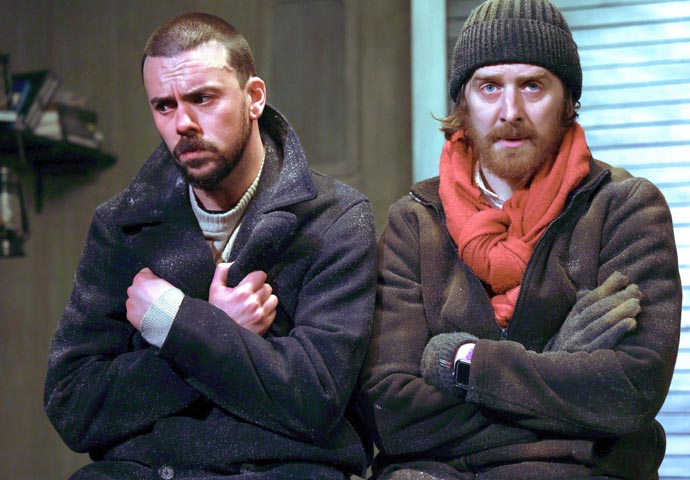
Ross Gaynor (Ashton) and Ian Toner (Reece) in A Slow Fire [Irem Akay]
His own adaptations of Curious Incident… and his 2023 version of Vanya, starring Andrew Scott, proved bona fide successes. But he’s “as proud of The Trial of Ubu, which until recently was the least successful show in the history of Hampstead Theatre”.
The glamour of commercial success isn’t necessarily his scene. He mops up some tea he’s spilt while gesturing to make his point.
“I didn’t particularly love the Olivier Awards”, he admits. “I’m much more comfortable talking politics with a journalist than getting a gong.”
I oblige, and we meander through ideology, talking about Britain, a land of “beauty and imagination, which just happens to be run by f***ing c**** who spread cynicism and scepticism”. His words.
I wondered what it was about this particular play that made Simon speak so passionately. A Slow Fire came to him in a jet-lagged dream, six years ago.
“Every image and moment was thought up at four in the morning. I usually plan my plays meticulously, but I just wrote down these scenes on my phone. I didn’t share it with anybody; I just looked at it every so often.”
That was until he showed it to his son.
“He’s my fiercest critic, and he said ‘that’s good, you should write that’. I don’t think it’s possible to be a parent and a sceptic. Parenting is built on the possibility that the world might get better.”
That outlook takes quite some optimism.
• A Slow Fire runs from August 20-September 26 at Jermyn Street Theatre, SW1Y 6ST. www.jermynstreettheatre.co.uk
