From rags to rags: our enduring fascination with Billy Waters
Building up celebrities only to knock them down is no modern phenomenon. Let’s not forget Britain’s ‘first black disabled celebrity’, says Angela Cobbinah
Thursday, 9th April — By Angela Cobbinah
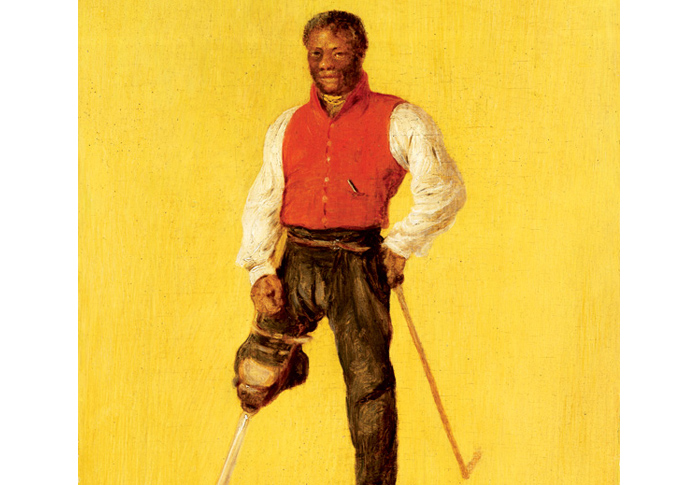
Billy Waters in 1815 has portrayed by Sir David Wilkie
NOT far from the British Museum there’s a blue plaque on the wall of a building in Dyott Street dedicated to celebrity busker Billy Waters who lived there more than 200 years ago with his wife and two children.
This otherwise unremarkable street was once part of the St Giles Rookery, a notorious maze of fetid alleys and underground passageways that was home to people who had nowhere else to go, immigrants and outsiders like Waters, a black former Royal Naval officer originally from America who’d lost a leg after falling from the high mast of a ship.
To supplement his small naval pension, Waters managed to reinvent himself as an entertainer and quickly became a singing and dancing sensation, noted for his flamboyant attire and ability to kick out his wooden leg to the rhythm of the rigs and reels he played on his fiddle on the streets of the burgeoning West End between the Strand and Piccadilly.
He became so popular that it is said that every child in Regency London knew of him. Hailed by leading dramatist of the day Douglas Jerrold as a “genius”, he was frequently depicted in contemporary prints and paintings, including one currently on display at the Royal Maritime Museum, as well being the subject of a series of Staffordshire porcelain figurines.
After being featured as a character in a sell-out play, Waters became even more famous. Yet he died in the St Giles workhouse and was buried in a pauper’s grave at St Pancras Old Church.
However, he remains a subject of deep fascination, as demonstrated by a concert at English folk song and dance centre Cecil Sharp House that was staged last week to mark the 250th anniversary of his birth. Performed by a core ensemble of four musicians plus guests, Jump Billy tells the story of his life through song to evoke the triumph and tragedy of what narrator Suchitra Chatterjee described as Britain’s “first black disabled celebrity”.
It is mostly informed by the show’s creator, Dr Mary L Shannon, who, in the absence of Waters’ own personal account, has pieced together the first biography of him, Billy is Dancing, from all manner of archives.
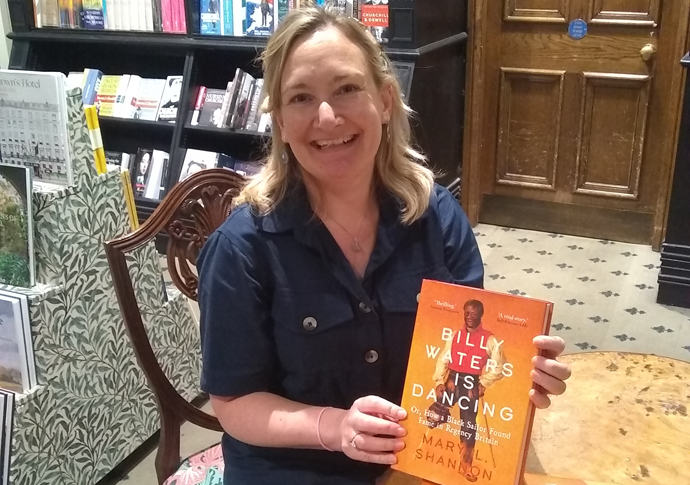
Dr Mary L Shannon with her book
Although it is not clear whether Waters was born into slavery, we learn he grew up in its shadow in New York, nevertheless absorbing the lively waterfront culture around him, from where it is reckoned he picked up the performance skills that would stand him in good stead for the future.
In 1811, aged about 35 and already an experienced sailor, Waters joined the Royal Navy as an able seaman and was soon promoted to petty officer.
His life-changing accident left him with a leg amputated below the knee but also the determination to survive. And so, sings Angeline Morrison in her eponymous title song, Waters goes from “rags to rags” to become the celebrated “King of the Beggars”, conspicuous in his feathered tricorn hat, scarlet waistcoat and sailor’s trousers as he plays outside the Adelphi on the Strand, one of his most lucrative pitches.
His music drew on his African American roots and life as a seafarer and included his signature song, Polly Will You Marry Me?, Polly being his pet name for his wife Elizabeth.
While he enjoyed the status of a folk hero, Waters lived a precarious existence, vulnerable as he was to the same routine bigotry experienced by other black people who had settled in London in the early 1800s, estimated to be 15,000 in number.
Racist caricatures of him by well-known artists of the day like George Cruickshank are just an echo of the crude depiction of him as an unlovable rogue in Tom and Jerry, a show that played to packed houses in its portrayal of London life in 1821.
Although it made him even more famous, it would prove to be his downfall. Overnight, people stopped throwing pennies into his hat and he fell into poverty, dying just two years later.
Still, Waters’ name lived on through modified versions of Tom and Jerry that would go on to tour America, while reproductions of the original Billy Waters porcelain figurines were still being produced for sale in the 20th century.
It is in this century that his rehabilitation has begun in earnest, with the poem, StaffordshireFigurine, 1825, by Pulitzer Prize winner Rita Dove, seeking to give him the dignity he’d been denied. Coinciding with the installation of the Dyott St plaque by Nubian Jak in 2023 was an Early Day Motion tabled in parliament by Labour MP Bell Ribeiro-Addy recognising Waters’ contribution to popular British culture.
Meanwhile, Dr Shannon herself has helped create an education resource pack on Waters’ life for the secondary school curriculum.
“Billy Waters demonstrated astonishing resilience in the face of multiple challenges,” she said. “His story is one of success. It’s not telling a story of slavery, chains and oppression. We can’t recapture Waters’ voice or the lost performances of the past. But we can ensure that if we explore his world, Billy Waters is dancing.”
• Billy Waters Is Dancing: Or, How a Black Sailor Found Fame in Regency Britain by Dr Mary L Shannon. Yale University Press, £25
• Cecil Sharp House, Regent’s Park Road, NW1 7AY, www.efdss.org/cecil-sharp-house
