Dots and pure colour
John Evans views the National Gallery’s ‘first’ show of the Neo-Impressionists
Friday, 19th December 2025 — By John Evans
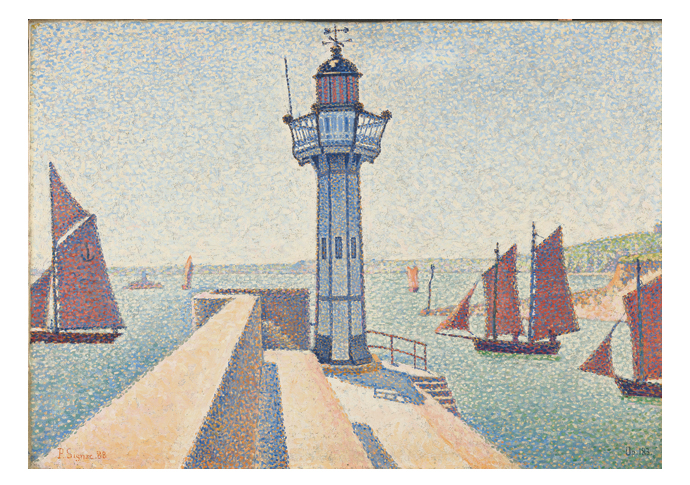
Paul Signac, Portrieux, the Lighthouse, Opus 183, 1888, oil on canvas, 46 x 65cm,(KM 104.721) [© Collection Kröller-Müller Museum, Otterlo, the Netherlands. Photographer: Rik Klein Gotink]
THE first National Gallery exhibition devoted to the Neo-Impressionists is a spectacular collaboration with the Kröller-Müller Museum, Otterlo, Netherlands.
Most of the works are by way of Helene Kröller-Müller (1869-1939), who was born in Essen in the Ruhr, the daughter of a wealthy industrialist.
And she became one of the first European women to amass an important art collection.
The National says: “Kröller-Müller, assembled what is probably the world’s greatest and most comprehensive collection of Neo-Impressionist paintings just two decades after these works were painted,” and was a “pioneer in displaying modern works of art on white walls”, in a museum.
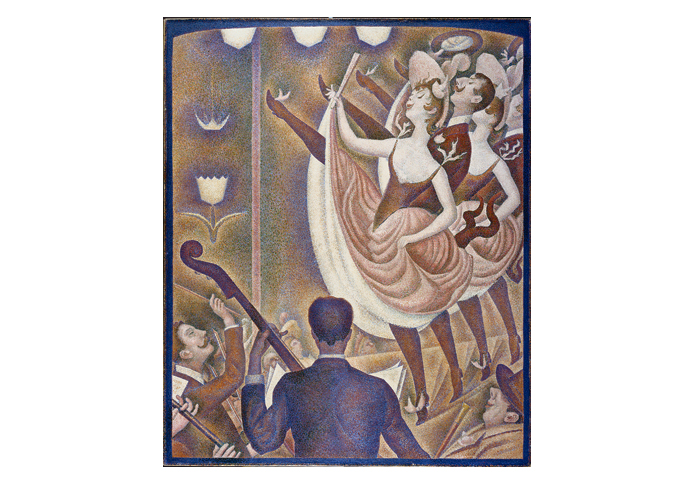
Georges Seurat, Le Chahut, 1889-90, oil on canvas, 170 x 141cm [© Collection Kröller-Müller Museum, Otterlo, the Netherlands]
The entire collection was eventually given to the Dutch government, on condition that the museum be built for it. And there it is today, the estate, complete with sculpture garden in De Hoge Veluwe, one of the largest national parks in the country.
Kröller-Müller was an early champion of Vincent Van Gogh (1853-1890) and today the museum has the second largest collection of his paintings and drawings in the world. But the focus with this current show is, of course, different and apart from his June 1888 oil, The Sower, he doesn’t really feature.
Georges Seurat (1859-1891) and Paul Signac (1863-1935) are the stars, and the show highlight is the former’s can-can dancers, Le Chahut, shown here for the first time in the United Kingdom.
It’s a startling example of the Neo-Impressionists’ radical break that occurred from the mid-1880s.
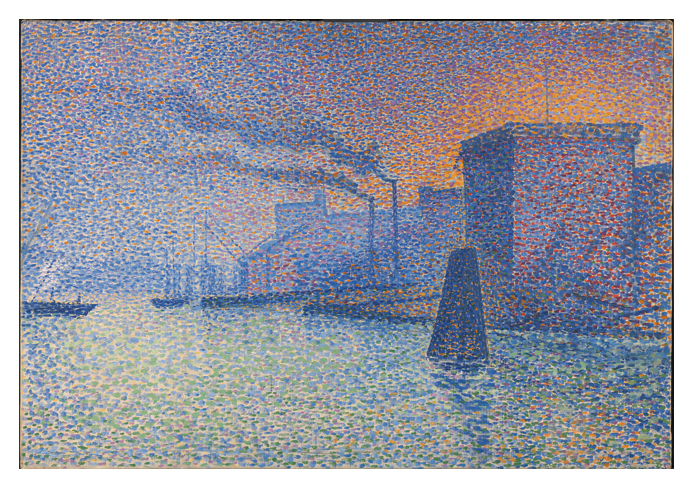
Georges Lemmen (1865-1916), Factories on the Thames, c 1892, oil on canvas, 69.5 x 98.5cm (KM 102.977) [© Collection Kröller-Müller Museum, Otterlo, the Netherlands. Photographer: Rik Klein Gotink]
The empirical realism of Impressionism was challenged. Signac described the aim: “Divisionism is a method of securing the utmost luminosity, colour and harmony…” with pure colour and dots, or otherwise no mixing of colours and pointillism, in simple terms!
The show explores the radical nature of the works, as the National says, “…both in the way that they were painted, and in political underpinnings of the Neo-Impressionist movement with artists reacting against the industrial age with a desire to reshape society by painting the struggles faced by the working class”.
In addition to Seurat and Signac, those particularly well represented include Jan Toorop (1858-1928), Théo van Rysselberghe (1862-1926) and Henry an de Velde (1863-1957).
As well as the core Kröller-Müller works, there are, in addition to the National’s own paintings, other loans from private collections and institutions, including the British Museum, Tate, Antwerp, Bremen, the Museum of Modern Art New York, and more.
• Radical Harmony: Helene Kröller-Müller ’s Neo-Impressionists is at the National Gallery, Trafalgar Square, WC2N 5DN until February 8. See: nationalgallery.org.uk
