Bold experiments
John Evans views the Tate’s major survey exhibition of Whistler’s work
Friday, 17th July — By John Evans

James McNeill Whistler, Arrangement in Grey and Black No 1, 1871 [Musée d’Orsay, Paris, France]
FIVE years in the making, the new Tate Britain Whistler show is the first major exhibition of the artist’s work in Europe for 30 years, offering over 150 pieces in all mediums.
Noting that terms of museum bequests make in-depth, “survey” exhibitions covering his career a particular challenge, the Tate stresses the importance of Massachusetts-born James McNeill Whistler (1834-1903) as “a key influence on European post-impressionists and the aesthetic movement in Britain”.
An exceptionally extensive accompanying catalogue, edited by Tate curator Dr Carol Jacobi, details the complexity of collaborations, loans, and backing that brought this show together.
Works include paintings, drawings, prints, designs, and sketchbooks, from as early as Whistler’s youth in St Petersburg (his father was recruited by Nicholas I to work on a Russia railroad) and at the US military academy West Point, to his late self-portraits, famous painting of his mother (above right) and remarkable collection of his “nocturnes”, atmospheric landscapes ranging from Chile to the Thames and Venice.
As the Tate notes, these “provoked bitter arguments among artists, patrons and critics, and even a court case, resulting in his bankruptcy and exile from London”.
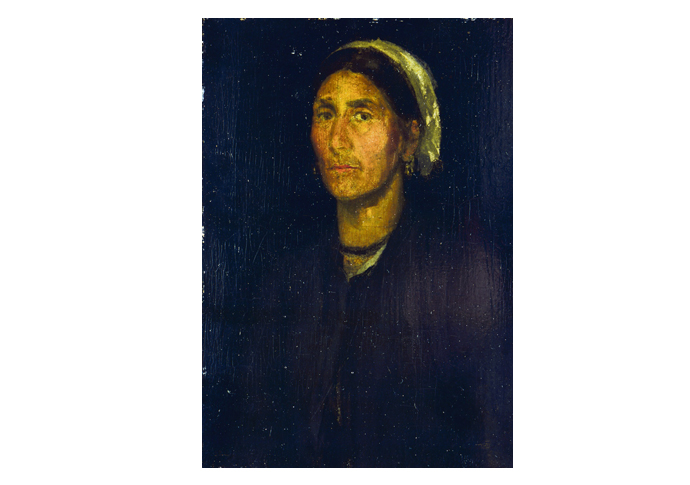
James McNeill Whistler, Head of a Peasant Woman, 1855-58 [© The Hunterian, University of Glasgow]
Four major self-portraits feature, including The Artist in His Studio from 1865-6 and Whistler Smoking 1856-60, not shown since his death.
Beyond headline works though, there’s much more. There’s a reproduction of the print version of Mr Whistler’s Ten O’Clock public lecture of February 1885 in Piccadilly, in which he defended “art for art’s sake”, arguing that nature is very rarely right… and only the artist, ”brings forth from chaos, glorious harmony”. As a controversial celebrity artist, he would also pointedly declare that “painting from nature… should be done at home.”
There are also rare and poignant 1896 lithographs, The Siesta, and Evening, Little Waterloo Bridge, from a very personal series dating from Whistler’s and his wife Beatrice “Beatrix” Philip/ Godwin’s last days together at the Savoy Hotel. She died aged 38 of cancer. They had been married just eight years.
After four years in Paris, in London from about 1860 he was among the first to depict its smogs and mists (Chelsea in Ice, 1864, is an example, a loan from Maine); there is also his larger oil, Wapping, with working people relaxing on a Thames pub balcony, seen as a challenge to Victorian tastes.
Whistler carried small sketchbooks during extensive travels – on four continents, with the final two decades of his life spent roaming Europe and north Africa – and would sign even some simple sketches with a butterfly motif, which referenced his initials, as complete works.
“He grew increasingly experimental and his style became more atmospheric and abstract”, the experts say. So too with portraiture, whether “society”, street vendor or family members.
There are also examples of his brushes and discussion of how he was inspired by the brushwork of Velázquez, Rembrandt (as can be seen in the small portraits Head of a Peasant Woman 1855-8 and La Mère Gérard c 1858-9) and of his experimenting with paint textures.
• James McNeill Whistler is at Tate Britain SW1P 4RG until September 27. Tickets at tate.org.uk / 020 7887 8888.
A hard map to follow

Emilio Isgrò, Prayer for Europe, 2016
THE artist’s Poesia Jacqueline, 1965, references a news event of the period that he knew would be familiar to many.
The artwork itself is acrylic on emulsified canvas mounted on wooden stretcher, it comprises a single white-out-of-grey arrow to the right, pointing down and to the left.
This is accompanied by a line of text: “Jacqueline (indicated by the arrow) bends over her dying husband.”
That is all, nothing more. But a wall note accompanying Emilio Isgrò’s work gives a short explanation of what this is intended to depict, or mean, stimulate, or suggest.
Or maybe not!
The Milan-based, Sicilian-born 88-year-old is the subject of an intriguing restrospective of some 35 works at the Estorick Collection* covering ”more than six decades of innovation” from “early works of visual poetry”, and his “Cancellatura” (erasure) of text which, he suggests, “does not destroy but creates; it does not censor but reveals.” That also covers obscuring place names on maps and globes.
A new work, Brexit, created for this show, mixed media and 22-carat gold on sheets of paper mounted on wood, is in the form of a 10 Downing Street letter from the PM, dated “29 March 2017” to “Dear President Tusk”. Just a small number of words are legible with the others obscured in black and gold. There’s another wall note.
But best check yourself…
• Emilio Isgrò: Erasing to Create is at the Estorick Collection of Modern Italian Art, Canonbury Square, N1 2AN until September 6. estorickcollection.com
