‘Ambitious’ plan for Square gets the green light
City councillors say development is exciting and innovative
Friday, 19th December 2025 — By Adrian Zorzut LDRS
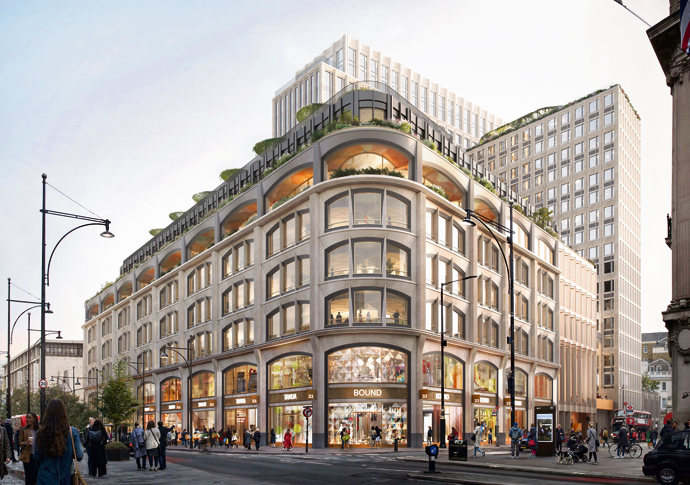
An impression of how the Berkeley Estate Asset Management Cavendish Square scheme could look
A NEW office block with a “cultural hub”, food hall, and shopping space has been given the green light to be built in Oxford Street.
Westminster councillors voted unanimously in favour of Berkeley Estate Asset Management’s scheme at 33 Cavendish Square at a planning meeting on Tuesday.
City councillors said the development, which takes up a full street block, was exciting and innovative.
Conservative West End ward councillor Paul Fisher, said it was one of the most impactful applications he has sat through. He said: “I’m pleased to see developers lead the way on what Oxford Street could look like. Rather than politicians it’s developers who have paved the way for sustainability, and on design, and I hope this becomes a sign of what Oxford Street could look like in the future.”
Labour West End ward councillor Patrick Lilley said the design was “the direction Oxford Street could go to be very successful”. Committee chair Jason Williams welcomed the addition of a “culture hub” while Conservative councillor Jim Glen said, though he regretted the loss of some of the original buildings, the scheme “hugely outweighed the loss”.
Members were told the development included more than 1,000 cycle parking spaces, a cultural auditorium able to hold up to 300 people and up to 75,000 sq m of high-quality office space and landscaped terraces.
Solar panels would also be installed on roofs.
Peter Pulford, for Berkeley Estate Asset Management, said the scheme would support 4,500 jobs and bring in £550million in economic benefits to the area.
He said: “This is a once-in-a-generation opportunity to transform a site that is strategically important to Westminster.
“Our ambitious and responsible proposals respect the past while responding to the existing context and the area’s evolution.”
Objectors called on the council to stop Berkeley from tearing down the former home of the London College of Fashion, which is located on the same block. They said the building was a “creative landmark” and could be retrofitted.
“To demolish the site is not to just remove the building, it is to erase a story, a story that belongs to London; and once that story is gone it cannot be rebuilt”, one objector said before they added: “We have the talent, the expertise and the community support to reimagine this building.”
Westminster city planning officers and the applicant’s architect, John Bushell, said the building was outdated, not fire safe, and had deep foundations which interfered with the rest of the development.
An officer said fabric from the building would be retained “as a memory”.
The site is currently home to three 1960s towers varying in height from 21 to nine storeys, mini-golf, leisure centre and gym, as well as a pub and food hall. It also includes empty teaching space last occupied by the University of the Arts, of which the college of fashion is part, before it relocated to a new campus in Stratford east London.
Berkeley applied for a “deep retrofit” of the site, according to a planning application. This includes refreshing the three towers and removing their core to create a more open-space plan. The owners want to demolish all low-rise buildings surrounding the towers, known as a podium, and replace them with modern retail space.
This includes tearing down the former college of fashion campus and replacing it with an eight-storey block and deepened basement.
The towers will remain as office space with floors between the 17th and 19th storeys possibly being turned into a viewing gallery and bar and food area. The newly-built blocks will include a mix of office space, cultural and creative floor space, restaurants, a pub, and food hall.
